
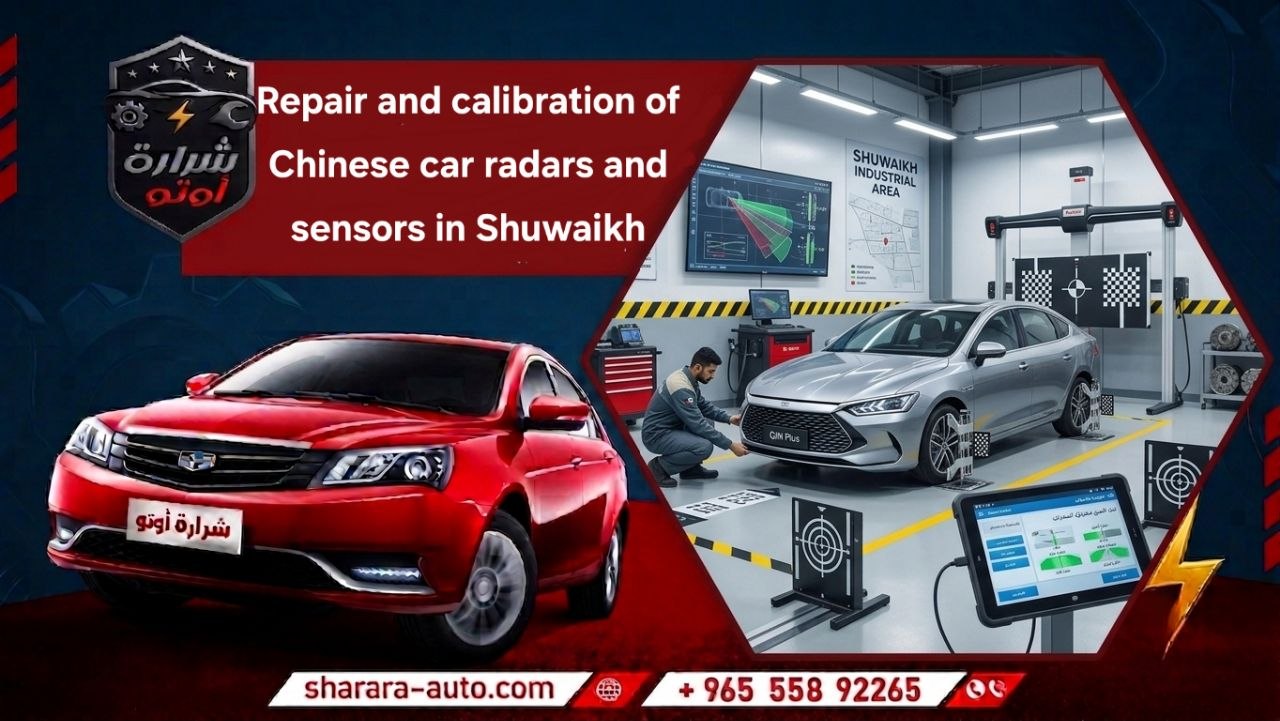
Repair and calibration of Chinese car radars and sensors in Shuwaikh
Repair and calibration of Chinese car radars and sensors in Shuwaikh55892265
The new generations of Asian vehicles are characterized by containing a super-smart digital safety package, but the efficiency of this system depends entirely on the accuracy of the reading angles of the sensors and cameras.
Here, Sharara Auto Center, managed by Ahmed Al-Zoubi, stands out as the first specialized workshop offering advanced engineering solutions in repair and calibration of Chinese car radars and sensors in Shuwaikh.
The center moves away from traditional manual adjustment methods that often fail to achieve the required balance, as the car is placed in a digital testing field that relies on laser reflectors and advanced optical scales to readjust the front radar and direct it by fractions of a millimeter, guaranteeing the return of its proper communication with the vehicle’s electronic brain and protecting it from false readings.55892265
Adjusting the efficiency of the automatic braking system and adaptive cruise control
The front car radar is exposed to continuous vibrations due to potholes or when dismantling the front bumpers to perform any mechanical maintenance.
Which leads to a slight deviation in the viewing angle that causes the smart cruise control to malfunction or trigger false collision warnings.
Therefore, Sharara Auto Center represents the first destination for repair and calibration of Chinese car radars and sensors in Shuwaikh services.
The technical staff, under the supervision of Engineer Ahmed Al-Zoubi, connects the car’s computer with the latest software of the parent factories to resynchronize the sensors responsible for the autonomous emergency braking system (AEB), and adjust the response range of the adaptive cruise control to completely fit the dimensions and traffic movement on local roads.
Repairing surround-view cameras and blind-spot sensors
Maintenance is not limited to the front interface only, but extends to include the side and rear sensors and 360-degree cameras, whose lens and software efficiency are affected by extreme heat and dust during the summer season. Hence, the center offers the comprehensive concept of repair and calibration of Chinese car radars and sensors in Shuwaikh operations.
The technicians at Sharara Auto are working on inspecting the electrical wiring harnesses connected to the side mirrors and rear bumper, addressing blind-spot detection (BSD) issues, and reintegrating the surround images for the main screen to appear with complete clarity and without any distortion in dimensions, giving the driver a full view that ensures safety while parking or overtaking.55892265
Common questions that concern modern car drivers
When does a Chinese car urgently need recalibration for radars and sensors?
Calibration must be performed immediately if the car is exposed to an impact in the bumpers (collision), or after replacing the front windshield (where the lane camera is located), as well as when changing front-end shock absorbers or performing wheel alignment, in addition to the appearance of an explicit error message on the dashboard stating the malfunction of advanced driver assistance systems (ADAS).
Does inspecting and repairing radar systems at Sharara Auto Center take a long time?
The precise digital inspection and laser calibration process takes approximately 45 to 75 minutes, as the maintenance includes testing the sensors in the field using road simulation devices inside the workshop to ensure the response of the radars and cameras to external factors with full efficiency before delivering the car to the owner.
How does harsh summer heat affect the radars and cameras of Chinese cars?
High heat reflected from the asphalt leads to excessive overheating in the microprocessors of the front sensors, which may cause a temporary disconnection in the system or the appearance of warning signs; Engineer Ahmed Al-Zoubi advises protecting the front camera behind the rearview mirror by placing thick sunshades while the car is parked, and avoiding washing the bumpers with direct, high water pressure that might move the sensors out of their place.